Safe AI for Patients on a Prescription.
Rules written by an MD and MS in Nutrition set the boundaries. Coaches supervise the plan. The prescriber stays in charge of the prescription.
TeraHealth's AI does not diagnose, prescribe, or make medication decisions. It generates personalized lifestyle coaching inside deterministic clinical rules, evidence-cited knowledge bases, and practitioner supervision.
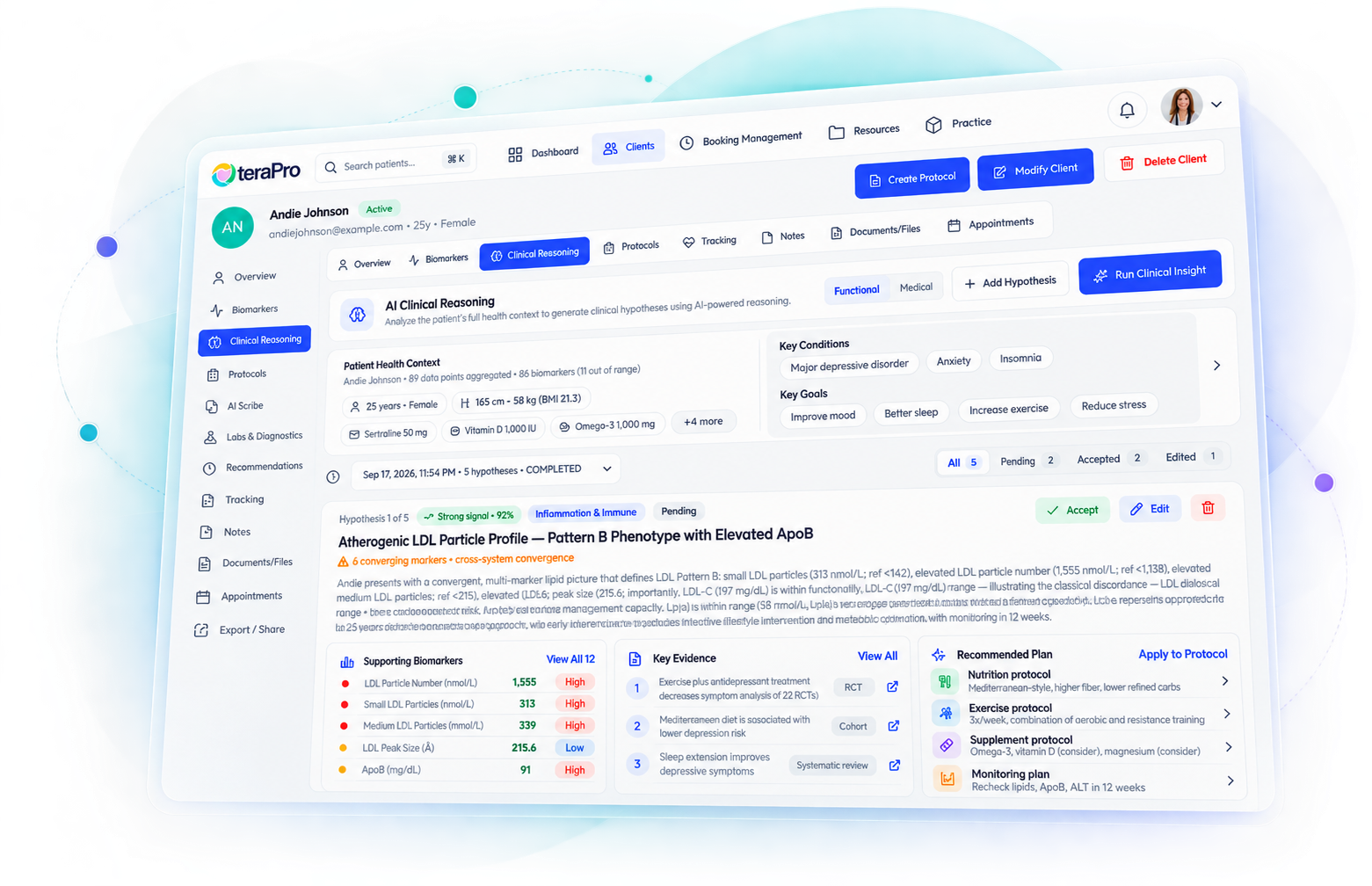
01
Practitioner-supervised by design. A health coach and a certified personal trainer approve every plan.
02
Rule-based, not AI-generated. Rules in our clinical knowledge bases decide; AI only integrates and summarizes.
03
Condition protocols are evidence-cited. Backed by peer-reviewed citations when the Clinical Reasoning Engine identifies a condition.
Why Safe AI matters
Why a chatbot alone can't coach a GLP-1 patient.
A patient three days into a new dose, feeling sick and thinking about quitting, is exactly the moment a language model on its own gets wrong. These are the four failures we designed out.
Failure 01
Plausible, wrong advice
An ungrounded model can tell a nauseous patient something that sounds right and isn't. Coaching a patient on a prescription drug can't rest on that.
Failure 02
Different answers on different days
The same side effect at the same titration step should get the same coaching every time. Free-running models don't guarantee that.
Failure 03
No audit trail
If you can't show a reviewer which rule produced a recommendation, it won't survive a compliance or clinical review.
Failure 04
No one accountable
Without a person approving the plan and a route back to the prescriber, the risk lands on the patient and on your brand.
Clear responsibility
Who does what.
The first question every clinical buyer asks is what the AI actually does. The answer is deliberately narrow, and every other job has an owner.
Rules
Clinical knowledge bases
Decide possible conditions, condition protocols, foods, and the coaching for each step of the drug's titration schedule.
Same inputs, same outputs, every time.
AI
Language models
Combine the rule outputs into one plan and write it in plain language for the patient and the coach.
Never generates a clinical hypothesis or a protocol.
Coaches
Health coach and certified personal trainer
Approve every plan before the patient sees it, then coach nutrition, exercise and sleep. General wellness guidance, not medical nutrition therapy.
Trainers certified by NASM or equivalent.
Your prescriber
Every decision about the drug
Dosing, labs, side-effect risk and anything outside lifestyle coaching. Safety rules send these straight back to your clinical team.
Stays with you, always.
The prescription stays with your clinical team.
Rules decide. AI communicates. Coaches approve. Prescribers prescribe.
Safe AI architecture
Three structural safety pillars. Not three features.
Safety is built into how the system reaches a recommendation, explains it and gets it approved before it reaches the patient.
Safety pillar 01
Deterministic clinical rules engine
Clinical rules, not a language model, determine the conditions, protocols, foods and coaching guidance used to build the plan.
Safety pillar 02
Evidence-cited recommendations
Condition protocols are backed by peer-reviewed citations, so the reasoning behind a recommendation can be reviewed and audited.
Safety pillar 03
Practitioner supervision
A health coach and a certified personal trainer review every generated plan, make edits where needed and approve it before the patient sees it.
Patient-facing output
Safe, evidence-grounded coaching.
The patient receives a personalized plan only after the clinical rules, evidence and practitioner review have all done their job.
Clinical rules determine. Evidence supports. Practitioners supervise.
GLP-1 safety
Safety rules built for GLP-1.
GLP-1 coaching has its own safety rules because the patient's needs change with titration, side effects and changes in treatment.
Titration-aware
Coaching changes with the patient's current dose and stage of treatment.
Side-effect overlays
Known side effects trigger specific nutrition, hydration, exercise and lifestyle guidance.
Escalation to prescriber
Questions about dosing, labs, side-effect risk or anything outside lifestyle coaching go back to your clinical team.
Switch path
When treatment changes, the coaching plan follows the patient's new medication path instead of continuing the old one.
The four knowledge bases.
Each one is maintained by TeraHealth and versioned, so the same inputs always lead to the same rule outputs.
Biomarkers → Conditions
From biomarker results to possible conditions.
- Hundreds of biomarkers, mapped deterministically to the possible conditions they point to
- The Clinical Reasoning Engine ranks the possible conditions and surfaces them for a practitioner to confirm
- No condition protocol is drafted until a practitioner confirms the condition
Built and maintained by our Clinical Lead (Medical Doctor and MS in Nutrition & Longevity)
Conditions → Protocols
From a confirmed condition to an evidence-cited protocol.
- Each condition the Clinical Reasoning Engine identifies maps to protocols across six domains
- Every protocol line carries a peer-reviewed citation
- Practitioners can open any line of the protocol and inspect the citation behind it
Built and maintained by our Clinical Lead (Medical Doctor and MS in Nutrition & Longevity)
Conditions & Goals → Foods as Medicine
From what the patient has and wants to what they eat.
- 1,000+ whole and minimally processed foods, each mapped to the conditions and health goals it supports
- Turns nutrition guidance into specific foods the patient can buy and cook
Built and maintained by our Clinical Lead (Medical Doctor and MS in Nutrition & Longevity)
Drug → Coaching Protocol
From the prescription to coaching for each phase of therapy.
- Drug profiles: injectable and oral GLP-1s, plus the maintenance phase after stopping
- Titration-phase templates: coaching mapped to each step of the titration schedule, updated when a schedule changes
- Side-effect overlays: coaching for the side effects that make patients quit, such as nausea, constipation and muscle loss
- Safety rules and escalation: anything about dosing, labs or risk goes straight to the prescriber
- Switch path: guidance for patients moving from a GLP-1 to a non-GLP-1 weight-loss drug instead of quitting
Built and maintained by our Clinical Lead (Medical Doctor and MS in Nutrition & Longevity)
Clear clinical boundary
TeraHealth's AI does not practice medicine.
We coach lifestyle: what patients eat, how they move and how they sleep while they're on therapy. Your prescriber makes every clinical decision about the drug. Our job is to keep the patient on the path your prescriber chose, and to send anything else straight back to them.