01
Practitioner-supervised by design
Tera AI generates; the licensed clinician approves. Every condition hypothesis, every protocol, every adjustment is reviewed and signed off before it reaches the patient.
Infrastructure providers are already adding coaching and registered dietitian services for GLP-1 patients as a module their client brands can turn on. The clinical engine underneath it — reasoning, protocol generation, and a patient app — is what we license, so you can offer it without building it.
50%
increase in GLP-1 drug adherence at month 12, with coaching
1
clinical engine serving every brand on your platform, each one white-labeled
6
lifestyle protocol builders, so coaching goes beyond food and exercise
The hard part isn't the app. It's the protocol library, the evidence base behind every recommendation, and the safety architecture that lets a clinician sign off on what the system produced.
A generalist coaching module gets a brand something to offer, but the guidance is thin — the same advice regardless of which program the patient is on, or which drug they take.
Going deeper means hiring clinical staff to write protocols, sourcing and maintaining the evidence base, and building the review workflow that keeps a licensed clinician in the loop. That is a multi-year clinical build, not a sprint.
Clinical Reasoning maps each patient’s overall health — their conditions, history, and the specific drug, like a GLP-1 (glucagon-like peptide-1) medication — so the protocol builders can generate a plan personalized to that patient, cited and ready for a practitioner to approve.
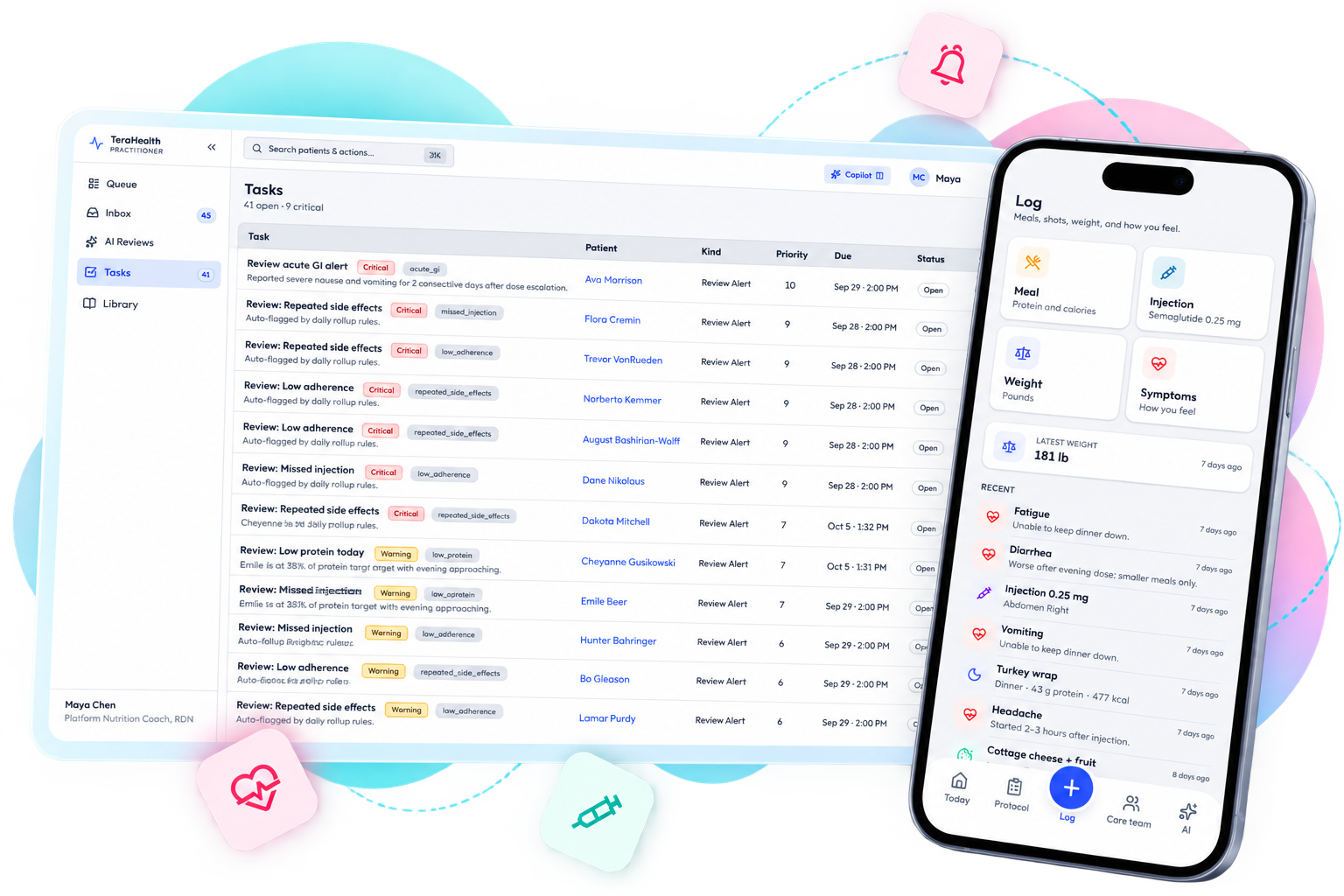
The Tera Patient Copilot delivers it daily — embedded in each brand’s own app or hosted under their name. One integration at your level reaches every brand on your platform.
A coaching layer needs reasoning, protocol generation, and a patient surface. These are the modules that provide them.
Maps biomarkers and patient context to possible conditions deterministically. The LLM (large language model) summarizes findings; the rules engine produces them.
Biomarker-driven meal plans, foods used as medicine, eliminations, and macronutrient targets personalized to the patient’s diagnostic and goal context.
Strength, cardiovascular, and mobility programs calibrated to functional capacity and recovery patterns.
Sleep architecture, circadian, and recovery protocols using HRV (heart rate variability), deep-sleep, and REM (rapid eye movement) signals from wearables.
Mind-body, breathwork, and parasympathetic recovery protocols matched to the patient’s stress profile.
Coaches patients daily between visits, and logs what the plan asks for: food, supplements, and workouts completed, plus symptoms the patient reports. That log feeds back into the protocol so it can be adjusted. White-labeled (hosted by Tera) or embedded as an SDK (software development kit) in your patient app.
All nine modules are available — these are the ones this use case starts with.
One integration at the platform level; each client brand turns it on without its own engineering work.
Step 01
Your platform connects to the Tera API Layer — patient events in, protocols and adherence back out.
Step 02
A client brand activates the coaching layer for a program. No separate build, no new vendor for them to manage.
Step 03
Their clinician — or a practitioner we supply — reviews and signs the generated plan before it reaches the patient.
Step 04
The Patient Copilot runs the plan between visits, under the brand’s name, and logs adherence and symptoms.
Step 05
The logged data feeds back into the protocol, with escalations routed back to the clinician.
Clinical defensibility is the precondition for embedding AI into any healthcare platform — three architectural pillars built to pass your compliance, legal, and clinical leadership reviews.
Tera AI generates; the licensed clinician approves. Every condition hypothesis, every protocol, every adjustment is reviewed and signed off before it reaches the patient.
Tera does not ask a language model to interpret biomarkers or a drug’s effects on its own. A proprietary clinical knowledge base maps lab results to functional ranges deterministically, then to conditions and protocols. That same knowledge base now also hosts drug-specific protocols — starting with GLP-1 nutrition and fitness protocols — mapped to the drug’s titration dosage phases and its known side effects, and personalized to the patient’s other health conditions. The model only summarizes what the rules produced.
Four knowledge bases built and maintained by our clinical lead (a Medical Doctor and MS in Nutrition) — biomarker to condition, condition to protocol, drug to protocol, and food to condition and health goal — with every mapping backed by peer-reviewed citations. Audit-ready and inspectable.
Pick the integration depth that matches your engineering capacity and brand requirements. All three deliver the same clinical AI underneath.
— I — API ONLY
You build the UI (user interface) inside your own application. Authentication via OAuth or API key. Modules return structured JSON your app renders natively.
— II — EMBEDDED SDK
Your brand, your styling, our clinical logic. Embed the modules as React components in your existing application without building the interface from scratch.
— III — MANAGED SOLUTION
Tera hosts the full practitioner portal and Patient Copilot. Custom domain, custom theme, our infrastructure — no engineering work on your side. And we provide health coaches and personal trainers.
Integration options
Choose how much of the interface you want Tera to provide.