Keep patients on their medications.
A Medication Companion keeps patients on their drug by coaching away the side effects that make them quit — and by running the diet, exercise, supplements, sleep and stress management protocols that push the drug's own results further. For telehealth, pharmacies and drug makers.
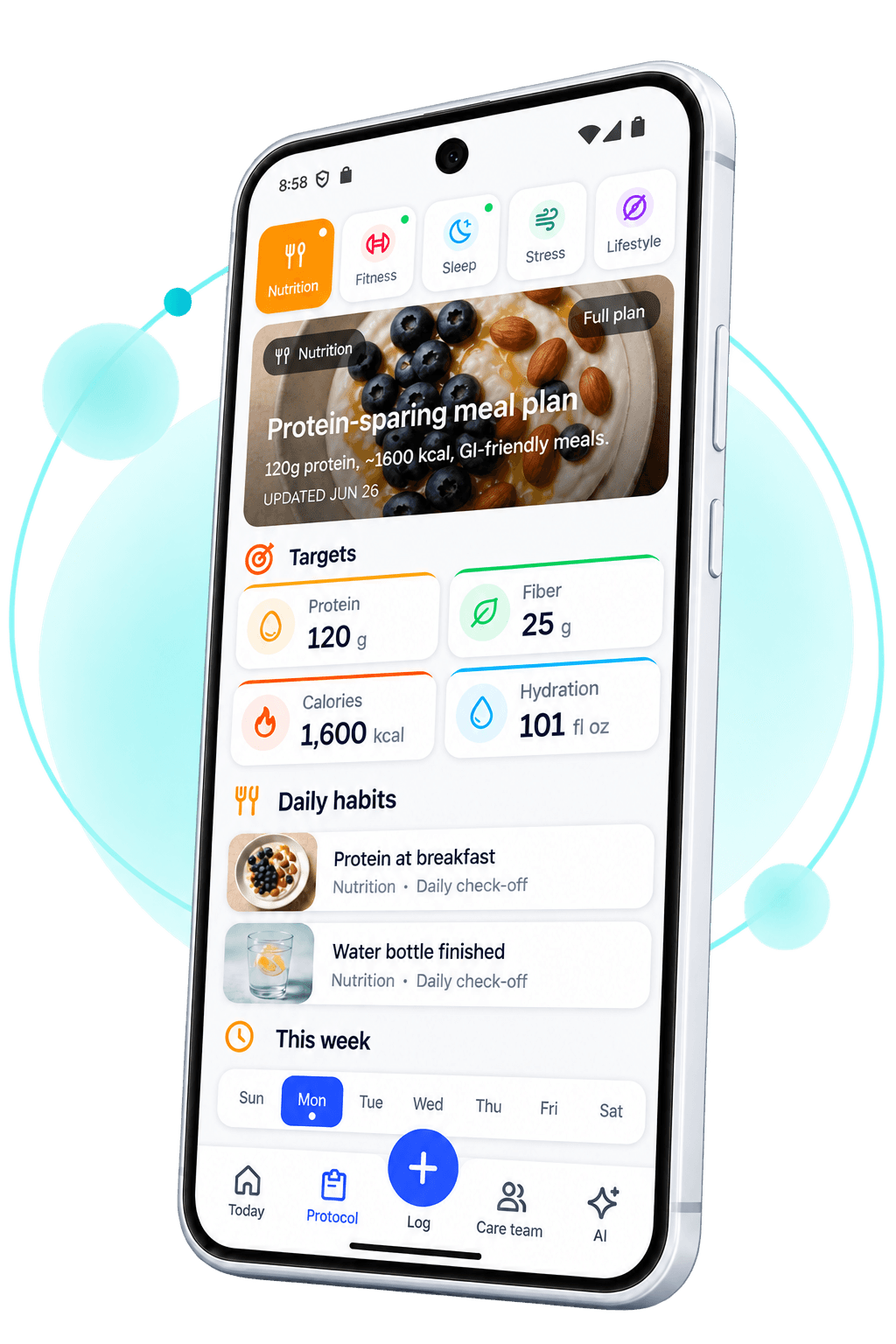
~130M
US adults — roughly half — take at least one drug that qualifies: taken for years, quit over side effects, and lifestyle-mitigable
Weeks 2–12
is when patients quit — side effects peak before the benefit has arrived
10
drug categories covered by one product with a per-drug playbook — and a patient on more than one is coached across all of them
Patients quit in weeks 2–12 — when side effects peak and the benefit hasn't arrived yet.
In every market we studied — GLP-1 (glucagon-like peptide-1), menopause hormone therapy, testosterone, antidepressants, statins — discontinuation clusters in the same window: the first three months, before the drug has shown what it can do. The exits are driven by side effects, not by the drug failing.
Start
the medication
Weeks 2–12
Highest risk window
Benefit
starts to show
54%
of GLP-1 patients stop within a year; 8% are still on therapy at three years
~50%
of statin patients stop in the first year, mostly over muscle symptoms
Up to 20%
of metformin patients experience a gastrointestinal side effect
3–4 mo
is when menopause hormone therapy side effects peak — in a therapy meant to run 10 to 15 years
The core fact: coached patients stay on the drug.
One coaching program published pharmacy-claims-confirmed persistence for GLP-1 patients against the largest real-world dataset available. The gap is the entire business case.
Without coaching
46%
at 12 monthsof patients are still on their GLP-1 after 12 months, in the largest US study (125,474 adults).
+21
percentage
points
With coaching
67%
at 12 monthsof patients in a published coaching program are still on their GLP-1 after 12 months, pharmacy-claims confirmed.
That program proved the mechanism — for one drug, sold only to employers and health plans, on a human-coaching cost structure. TeraHealth applies it to any qualifying drug, through any channel, at software cost.
Source: Omada Health, Enhanced GLP-1 Care Track 12-month analysis (Jan 2026); GLP-1 Flex Care announcement (Mar 2026).
What a Medication Companion is
An app that connects patients with practitioners and delivers daily lifestyle-medicine support — nutrition, supplements, fitness, sleep, stress, and eliminations — written for the specific drug the patient takes. It does two things at once: it reduces the side effects that make patients quit, and it improves the health outcomes the drug was prescribed to deliver. Three things follow:
The patient stays on the medication
Persistence — the drug delivers its clinical value only for as long as the patient keeps taking it.
The seller keeps its customer
Retention — every extra month on therapy is a month of subscription or drug revenue for the pharmacy or the drug maker.
The patient feels better
Quality of life — nausea, muscle loss, fatigue, and sleep disruption are predictable, and each has a known lifestyle answer.
How a Medication Companion works.
A coaching program that runs alongside the prescription, built around four ideas. Each one is covered in detail below.
Personalized to the patient.
Our Clinical Reasoning Engine reviews intake, lab tests, symptoms and session notes to identify possible conditions, so the program avoids anything contraindicated for that patient.
Six domains, not two.
Nutrition, supplements, fitness, sleep, stress and lifestyle interventions, because the often overlooked ones can decide whether the protocol works.
We supply the practitioners.
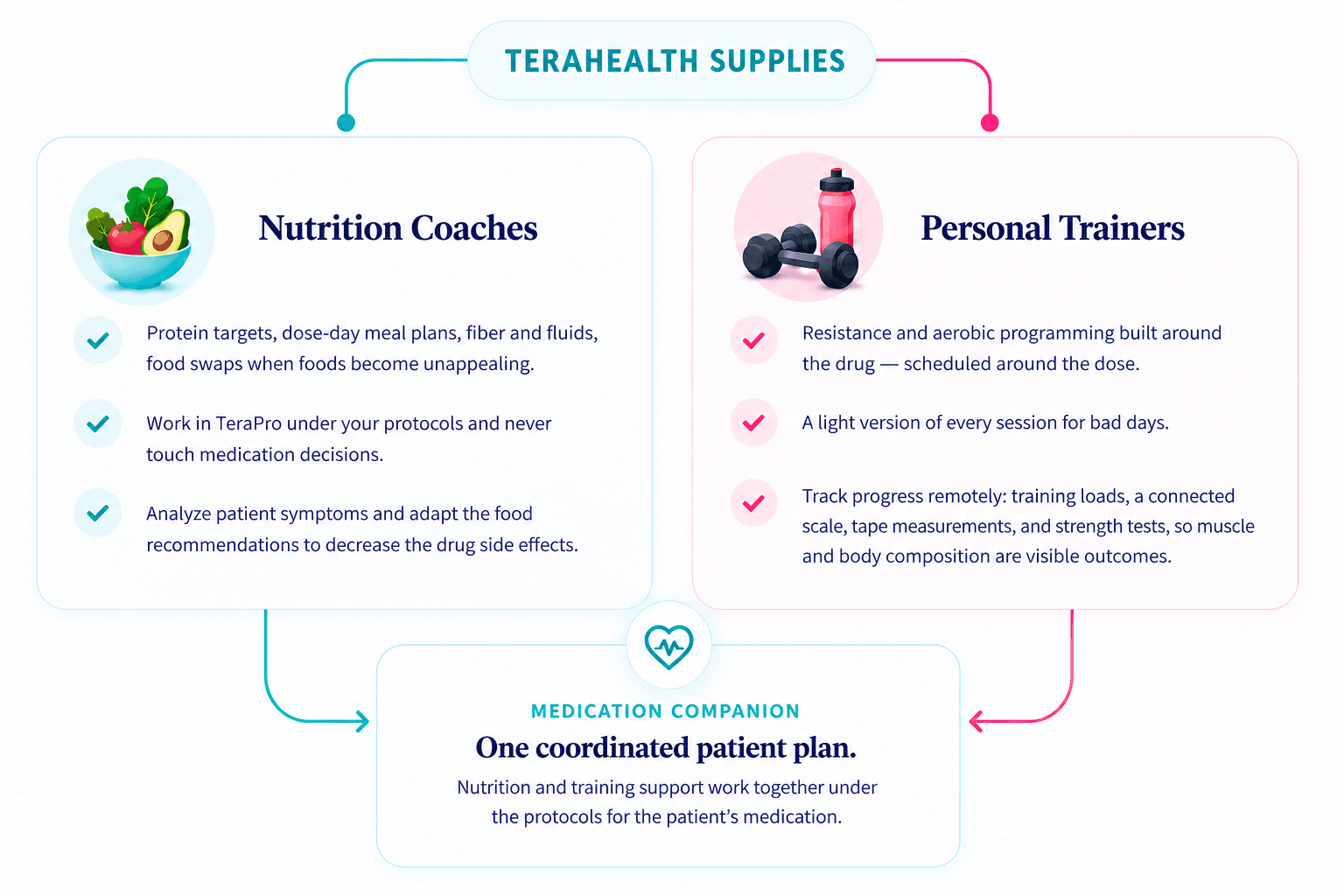
A health coach and a personal trainer approve every plan before it reaches the patient. Dosing, labs and medical risk stay with your prescriber.
Two ways to deliver it.
Managed Solution: we host and run everything under your brand. Build It Yourself: your team runs it on our engine through our API or SDK.
We personalize the coaching program to the patient's conditions.
Two patients on the same drug rarely need the same plan. Before anything is recommended, the program accounts for everything else going on with that patient.
Patient data
Clinical Reasoning Engine
The program accounts for the patient's possible conditions.
Our Clinical Reasoning Engine reviews the patient data available to it (intake answers, lab tests, reported symptoms and coaching session notes) and identifies possible health conditions using the rules in our clinical knowledge bases. These are not diagnoses; they are signals the coaching program takes into account across all six domains, so it doesn't recommend a food, supplement, exercise or habit that is contraindicated for that patient. As new labs, symptoms or notes come in, the program updates with them. A health coach and a personal trainer review and approve every plan before it reaches the patient, and dosing, labs and medical risk stay with the prescriber.
Applied across all six domains
Every plan is reviewed before it reaches the patient.
Dosing, labs and medical risk stay with the prescriber.
We coach six domains, not two.
Most companion programs coach food and exercise. Sleep, stress, and eliminations — often overlooked — can decide whether the protocol works: sleep determines whether weight lost is fat or muscle, stress determines whether habits survive after the drug stops, and a small number of eliminations undo both.
Nutrition
Supplements
Fitness
Sleep
Stress
Lifestyle Interventions
We supply the practitioners.
Most drug programs have only a prescriber. A Medication Companion needs two more roles: a health coach and a personal trainer. And you don't have to hire, credential, or manage either one. TeraHealth supplies both, already trained on the protocols for the drug your patient is taking.
Two ways todeliver it.
Option 01 · Managed Solution
We host and run everything under your brand.
We host and run everything: the patient app, the practitioner workspace, the protocol library, the reporting, the coaching network of health coaches and personal trainers.
It launches in weeks with no engineering work on your side.
Option 02 · You Build It Yourself
Your team runs it on our engine through our API or SDK.
Your team runs it on our engine through our API or SDK.
Who it reaches, and who pays
Most channels don't absorb the cost — they offer the companion to the patient alongside the drug, as a paid add-on. The channel gets the retention benefit; the patient buys the coaching. Where a buyer does pay directly, it's because persistence is already worth more to them than the fee.
Pharmacies
Who pays
The patient — a cash add-on at the point of fill, or an upsell at the point of pain when side effects kick in.
How it reaches the patient
At checkout, at the counter and in-app, or an upsell the moment a prescription is filled or when side effects kick in — in-app offer, notification, text or email.
Drug makers
Who pays
The manufacturer — a retained patient is worth $500–1,000 a month on a branded drug, well above the cost of the companion
How it reaches the patient
As a program administrator inside the manufacturer’s own patient-support program — or made available to its sales channels, so every pharmacy and platform selling the drug can offer the companion alongside it
Safety and clinical governance
Every plan runs under TeraHealth's own clinical protocols. The app coaches lifestyle; it never touches the prescription.
Lifestyle only
The app never recommends a medication, a dose change, or a formulation switch. Any dose question is the patient’s to bring to her own doctor.
Auditable by design
The Clinical Reasoning Engine works from a curated, cited clinical knowledge base — reasoning is traceable at every step, and the AI only summarizes for the practitioner to decide.
Licensed and compliant
Every practitioner is licensed and works under TeraHealth’s clinical protocols, and health data runs inside a HIPAA (Health Insurance Portability and Accountability Act)-compliant platform.
Medication categories
Every category, one product.
One companion, configured per drug. Each category below has its own page with the evidence, the protocol, and the economics specific to it.
Medication Companion categories
10 categories
One health picture
One patient,
several drugs.
Plenty of patients are on more than one of these at once — a GLP-1 and a statin, metformin and hormone therapy. The companion coaches all of them together from a single health picture, so the protocols reinforce each other instead of contradicting, rather than running a separate program per prescription.
Roughly 130 million US adults take at least one drug that qualifies. Hair loss, erectile dysfunction, and birth control fail the test — lifestyle does not meaningfully reduce those drugs' side effects.