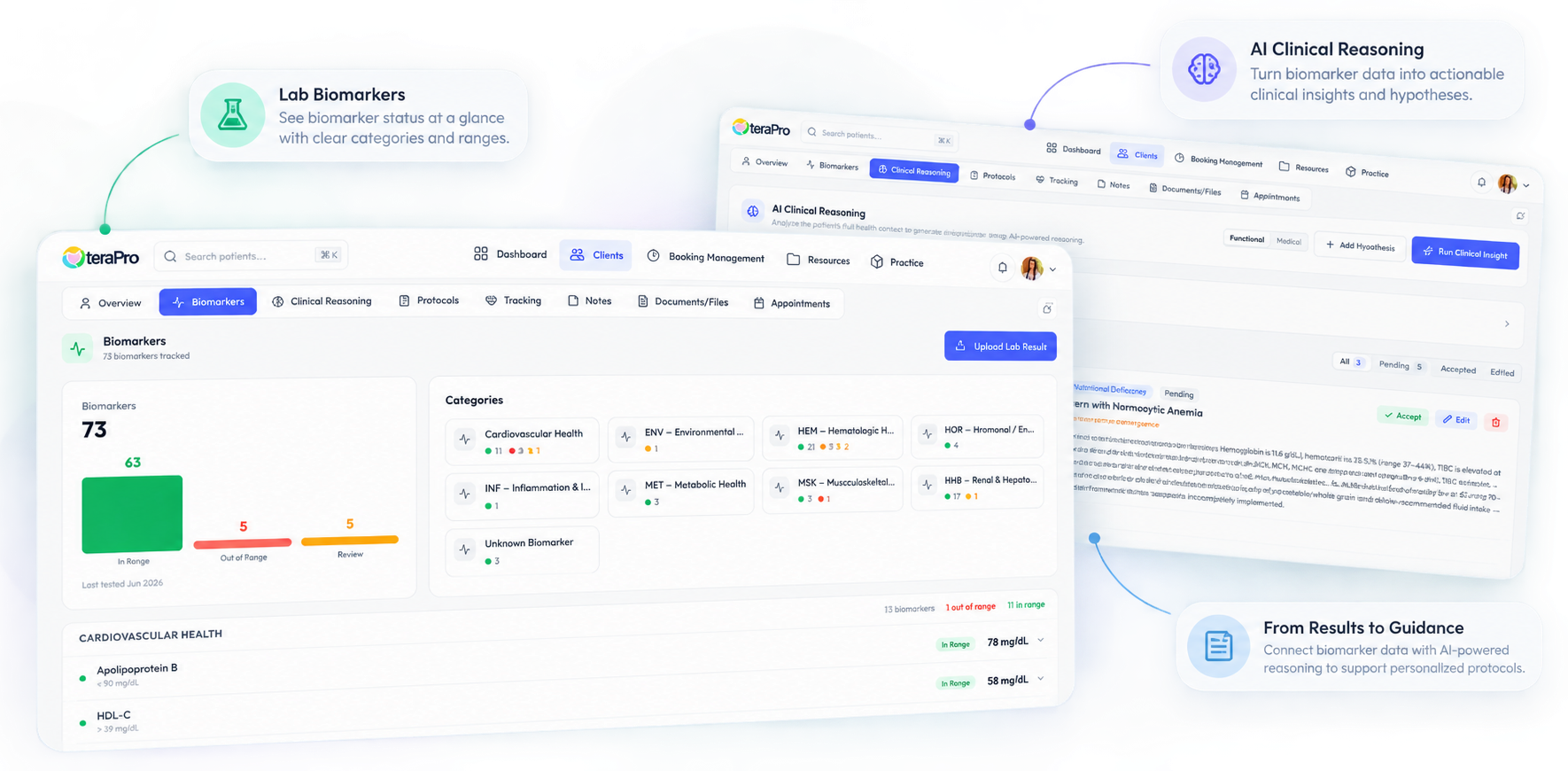
Turn a result into a plan.

A lab result tells someone what their numbers are. It doesn't tell them what to do about it. Clinical Reasoning interprets the panel and the protocol builders generate a personalized plan to move the markers that are out of range — for the ordering practitioner, or for the consumer who bought the test themselves.

Practitioner-supervised. Rule-anchored. Evidence-cited. HIPAA (Health Insurance Portability and Accountability Act)-compliant, BAA (business associate agreement)-ready.

Get a demo
TeraPro biomarker dashboard connected to AI Clinical Reasoning

2

products, two buyers — a practitioner tool and a consumer-facing one, on the same engine

Deterministic

mapping from biomarker to functional range to condition to protocol — rules, not model improvisation

Cited

evidence behind every mapping, so the interpretation is inspectable

The result is the product. The plan is what the customer actually wanted.

Both buyers have the same gap at the same moment — a panel comes back, something is out of range, and nothing in the product says what to change.

TODAY

A result and a reference range

For practitioner-facing labs: the ordering clinician gets the values and does the interpretation and planning themselves, off-platform. The lab's product ends at delivery, and so does its role in the outcome.

For D2C (direct-to-consumer) labs: the customer gets a dashboard of numbers, some flagged red. They search for what to do, act on whatever they find, and often never re-test — there is nothing to retain them.

Tera

WITH TERA MODULES

A result, an interpretation, and a protocol

Practitioner product: Clinical Reasoning delivers findings mapped to possible conditions with citations, and the protocol builders generate a plan the clinician edits and signs — inside your portal, as part of your offering.

Consumer product: the same engine produces a personalized protocol, with a practitioner reviewing it before it reaches the customer, and a natural reason to re-test in 12 weeks to see the markers move.

The shift

From reporting the result to supporting what happens next.

ResultInterpretationProtocol

Clinical stack

The modules this uses.

Interpretation plus protocol generation — and a patient surface where the product is consumer-facing.

Module 01

Clinical Reasoning

Maps biomarkers and patient context to possible conditions deterministically. The LLM (large language model) summarizes findings; the rules engine produces them.

Module 02

Nutrition Protocol Builder

Biomarker-driven meal plans, foods used as medicine, eliminations, and macronutrient targets personalized to the patient’s diagnostic and goal context.

Module 03

Supplement Stack Protocol Builder

Evidence-cited supplement stacks across cardiovascular, metabolic, hormonal, inflammatory, and longevity domains. Brand-aware.

Module 04

Tera Patient Copilot

AI patient portal that coaches patients daily between visits. White-labeled (hosted by Tera) or embedded as an SDK (software development kit) in your patient app.

All nine modules are available — these are the ones this use case starts with.

4 modules shown

From result to action

How it works.

The same pipeline serves both products; what differs is who reviews the output and who receives it.

01

Step 01

Result lands

A completed panel passes into Clinical Reasoning from your LIS (laboratory information system) or result pipeline.

02

Step 02

Findings generated

Values map to functional ranges and possible conditions deterministically, each with a citation.

03

Step 03

Protocol built

The builders generate a plan targeting the out-of-range markers — nutrition, supplements, and the other domains as indicated.

04

Step 04

Practitioner signs, patient acts

A clinician approves before anything reaches the customer. The plan runs daily, and the re-test shows whether it worked.

Clinical safeguards

Safe AI you can embed.

Clinical defensibility is the precondition for embedding AI into any healthcare platform — three architectural pillars built to pass your compliance, legal, and clinical leadership reviews.

Pillar 01

Supervision

Practitioner-supervised by design

Tera AI generates; the licensed clinician approves. Every condition hypothesis, every protocol, every adjustment is reviewed and signed off before it reaches the patient.

Pillar 02

Reasoning

Reasoning is rule-anchored, not improvised

Tera does not ask a language model to interpret biomarkers. A proprietary clinical knowledge base maps results and wearable metrics to functional ranges deterministically, then to conditions and protocols. The model only summarizes what the rules produced.

Pillar 03

Evidence

Every recommendation is evidence-cited

Three knowledge bases — biomarker to condition, condition to protocol, food to condition and health goal — with every mapping backed by peer-reviewed citations. Audit-ready and inspectable.

Clinical AI architecture

Rules produce the findings. AI communicates them.

Practitioner supervisedRule anchoredEvidence cited

Integration

Three ways to deploy.

Pick the integration depth that matches your engineering capacity and brand requirements. All three deliver the same clinical AI underneath.

I — API ONLY

Server-to-server REST API

You build the UI (user interface) inside your own application. Authentication via OAuth or API key. Modules return structured JSON your app renders natively.

II — EMBEDDED SDK

Drop-in React components

Your brand, your styling, our clinical logic. Embed the modules as React components in your existing application without building the interface from scratch.

III — WHITE-LABEL HOSTED

We host the interface; you brand it

Tera hosts the full practitioner portal and Patient Copilot. Custom domain, custom theme, our infrastructure — no engineering work on your side.

Integration spectrum

Choose how much of the experience you want to own.

API
SDK
Hosted
Your infrastructureTera infrastructure

Sell the plan, not just the panel.

Get a demo